Showing posts with label Books. Show all posts

Sunday, April 1, 2018

"The Knife of Never Letting Go" book review


I am not that fond of the young-adult genre even though I am inside that age bracket. These books typically have good premise that will make you buy them for their good synopsis stated at the back of the book, but the execution and how the story unfolds are told in a really bad way. This has been the face of YA novels for me, until I read Patrick Ness's first book of the Chaos Walking series: The Knife of Never Letting Go. I found out about this book because I'm a fan of Charlie Kaufman's films (Eternal Sunshine of the Spotless Mind, Adaptation, Being John Malkovich), and I read in his IMDB page that he is writing a film that is based upon this book. So I read it, and since the book is "unputdownable," I finished it in a few sittings. This is a perfect example of what YA novels should be. The premise is good and most importantly original: it is about a boy named Todd living in a world where there is a disease that kills women and make the thoughts of men publicly available for people to hear. He's nearing his fourteenth birthday, which is the time you are considered to be a grown man, when he suddenly found something (I don't want to spoil it). The story is told pretty well and merits the good premise. It's suspenseful and exhilirating to read because the book circles around a cat-and-mouse chase, but also leaves the readers moments to breathe and to know more about the characters. The protagonists are not one dimensional for they did a balance of good and nasty stuff. I heard some criticism about this book that it's too brutal. I think Ness intentionally made the book graphic for the main theme of the novel is to show how nasty violence is. It doesn't fetishize the act of killing, rather it shows how violence scars people's minds, especially the young ones. If you have read this book, you should know well what I'm talking about, because this book plays on the ethical dilemma of killing a person.

I will read the second book of this series once I got a copy already. I hope I get it soon, for the first book ended in a massive cliffhanger.

Sunday, March 4, 2018

Why Akira is a triumph in manga


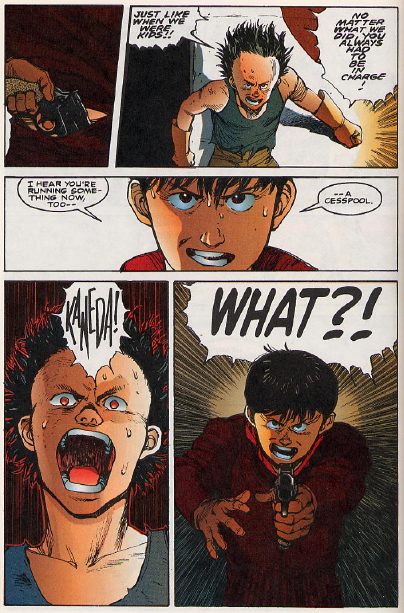
Akira is a manga created by Katsuhiro Otomo. The six-volume series is set is a post-apocalyptic Neo-Tokyo in the year 2019, built amidst the ashes of an unknown explosion that happened in 1982. Clues about the past catastrophe tend to resurface, and a youth gang lead by Kaneda managed to uncover government secrets. 
The manga explores human desires on power and corruption. Although Akira is a science fiction, the manga triumphs in the incorporation of realism in each of its pages. From depictions of three-dimensional characters to vivid painting of a dystopian future, Akira rose above of its kind due to breakage of common manga conventions.
Intricate Characters

A major problem in most of manga is the proliferation of one-dimensional characters. This is a trope wherein the only thing that describes a character is his/her motivations. All characters are designed to have motivations that force them to do some actions, which in turn drive the story forward. In reality, human beings tend to shape and be shaped of certain events. A one-dimensional character is a product of a writer who focused solely on the plot without giving one’s characters room to evolve. Otomo managed to give every character enough background for the readers to know them more. He managed to depict Tetsuo’s frustration as a weakling in the face of Kaneda. Kei, a character who was always overshadowed by her own gender, struggles to have importance in a testosterone-fueled society. The Colonel, the head of Neo-Tokyo’s Akira project, is powerless to protect Neo-Tokyo from chaos. These different aspects of human experiences are present in Akira which makes the characters more relatable to the readers.
Not in-your-face

Another common problem in a lot of manga series is the writer’s need to spoon-feed everything that is happening in the story. One manifestation of this is the frequent use of thinking bubble to portray what a character is thinking even though it is obvious to the reader what they feel. Current American comics doesn’t use this technique anymore and everything is portrayed using dialogue bubbles or narrations. It is very brave of Otomo to include such subtleties to be present in Akira, even though concepts like creation of a universe in one’s mind are complicated to discuss. It is up to readers to know and find out what is happening in the story on their own. This not-in-your-face method of telling a story in the graphic medium induces a two-way active connection with the reader. It requires more from the reader and the reward of finding out the truth in the story is more satisfying.

System on a Background of Chaos


Akira is a very chaotic manga. There are lots of action, graphic violence, and explosions. Even though this is the case, the chaos is laid down in every page in a systematic way that the reader still understands what is happening. One manifestation of the system is the use of non-overlapping grids in every panel which does not confuse readers on where panels start or end. The use of overlapping grids is prominent in a lot of manga especially on scenes where lots of action if happening. This is a bad practice since it multiplies confusion for the readers. Another manifestation is prior to the confrontation: the motivations of every character are known which makes readers understand layers of reasons and results of any battles.

Friday, June 23, 2017

One Hundred Years of Solitude Review

In One Hundred Years of Solitude, Gabriel Garcia Marquez opened the gate to the town of Macondo-- a realm that is under the threat of constant tragedies and bliss of colorful moments. At the center of it all is the Buendia family and their neverending struggle to attain solitude and to escape loneliness. The book is riddled with bizarre events and characters. The storytelling technique implored in this book is what makes Solitude different from the other books that I’ve read. Marquez successfully managed to blur the lines between what is real and what is fantasy that didn't left the reader hanging from the plot. It's amazing how he managed to contour the tone of his writing that it's solemn when the ongoing story is about war, gleeful when it's about death, and dreamlike when it touches something that is real.

The magical realism has a lingering effect on me, that whenever I contemplate this book, I felt like I once lived in Macondo and became one with the Buendias. No book has ever left me in awe as One Hundred Years of Solitude and I can't wait to visit Macondo again for another time.

Monday, December 19, 2016

'The Lost Hero' Review

This book is trying too hard to say that it is about Roman Mythology, that it is different from the previous series, yet the main gods and goddesses involved are just the same. The chapters are oddly separated; they're most of the time too short. The love story is very conspicuous, and I hate that Riordan didn't even bother to present it in a subtle way.
Everything is too 'in-your-face' like the author thinks his readers are too dumb to understand what he's saying. I think the problem is this: This book is for young adults but the author thinks he's still writing for children. His form of writing didn't change a bit and the choice of words and phrases are too childish, even though he's already targeting a new demographic.

Friday, August 5, 2016

Probability and Sherlock Holmes

I was always concerned on how Sir Arthur Conan Doyle uses probability to justify Sherlock Holmes's evidence in indicting a certain suspect. He always assumes that the more the events there are to imply, the higher the probability for the whole scenario to happen. The truth is actually the opposite. The more uncertain events you're presenting to prove a point, the lower the probability that we get the right conclusion.

For example, if you saw a man with a dirt on his shoe. You could imply from this that the man didn't cleaned his shoe last night. You can imply from this that the man is probably tired last night and doesn't have the time to clean it up. You can imply from this again that he probably have gone to party last night, that's why he didn't get time to clean his shoes. It can go on and on until you land to a conclusion that the man has a dog in his house.

The problem arises when you put implication over another implications. Because you are never sure in every implication, the probability of the whole scenario that the man has a dog will be diminished. To address this problem you need to put another evidence to improve every level of implication. For example you know that it didn't rain morning of that day, then the event of him cleaning his shoe last night will be more probable to happen. Doyle uses this most the time. He puts more evidences in every level of Sherlock's implication. Still, we are uncertain in every conjecture that we devise, no matter what happen, the conclusion that we get that the man has a dog in his house will be more uncertain to happen. It is not the other way around that if we deal with more implications, the higher the certainty for the conclusion to be true, even if you could see that the whole story fits.

Tuesday, August 2, 2016

Harry Potter and the Cursed Child review

Albus Severus is having a hard time being overshadowed by his overly famous father, Harry Potter. In order to create his own name in the wizarding world, he and his friend, Scorpius Malfoy, will embark upon a task to change the past and save a life. Meanwhile, secrets from the past are being unravelled and new dark forces are coming about. The new generation of the wizarding world is again in deep trouble.

The first part of The Cursed Child was really nostalgic. It brings us again to the epilogue of The Deathly Hollows where Albus is first time to ride the Hogwarts Express and is discussing to his father the possibilities of him being sorted to Slytherin. Hogwarts had changed, yet certain customs like sorting students in their respective houses using The Sorting Hat is still present. The entire premise is intelligent and imaginative. Using the time turner to save a life of a deceased character is a great fun to read. It tickles the mind of the readers on some possibilities on what might have happened if Dumbledore's army lost the Battle of Hogwarts. It also lets us meet some of the characters that had passed away in the battle. The new generation of characters are colorful and they didn't drag the whole story down. Scorpius and Albus forms a great tandem that is reminiscent of the book series' trio: Harry, Ron and Hermione.

There some instances that they included plots in the book that is not on par with their universe. Things like the escape from the Hogwarts Express (seriously, that thing is dumb), the quickly made polyjuice potion just to fit the story, and somehow out of the blue conversation about fears of pigeons. I imagine lots of the diehard Harry Potter fans cringing on those scenes. Also, other key characters are not present in the story. Neville Longbottom (my favorite character in the book series) didn't join the old gang. Neville is actually a faculty member of Hogwarts now and most of the plot is in the school, that is why it is hard to understand why they didn't give him any parts of the story.

Harry Potter and the Cursed Child is a  satisfying yet flawed continuation of the beloved franchise. It brings back all the memories we have from the original book series and gives us one last taste of the magic it brought to us, although it doesn't offer more than nostalgia.

Saturday, July 9, 2016

A Study in Scarlet Review


Holy sh*t that was amazing.

This is the very first Sherlock Holmes book I've read. And man, I'm hungry for more after finishing this one. The first encounter of Watson and Holmes is fun to read. The affinity between them is well established from the first ten pages of the book. The first half of the book is narrated from the journal accounts of Watson and not Holmes himself. The other half is a fly on a wall point of view of the revenge tale of the prime suspect of the case. Both are well written and are easy to read.

The problem that I always encounter when I'm reading flashbacks is the information overload. You can't follow the story because the author is trying to give lots of plot points in a limited number of pages. This is not the case in A Study in Scarlet. The part where there is a flashback to explain the motives of the suspect is not difficult to read. Even the part where Holmes is already explaining the reason why he had gotten the right conclusion is not a pain in the mind of the readers.

A Study in Scarlet is full of absurd instances and characters but Doyle made everything in it realistic for the enjoyment of everybody.